Glamsterdam has not shipped yet; it is live on the Platåberget testnet and heads to Sepolia and Hoodi next, as covered in our Glamsterdam hub. But Ethereum’s fork pipeline does not wait. On September 7, 2026, the Ethereum Foundation’s Protocol Cluster published “The Hegotá EIP Opinion Post and Tier List”, the first real look at the scope of Hegotá, the fork after Glamsterdam. It grades 62 candidate EIPs using 397 individual assessments from across the Protocol Cluster, and it names exactly two of them must-ship.
This post is the reference version of that list: what Hegotá is, how the tiers work, what the two headliners actually do, and which of the remaining sixty proposals are worth knowing about. Everything here reflects the tier list as published on September 7 (updated September 8); it is an opinion document, not a meta EIP, and we will update this page as Hegotá’s scope formalizes.
Where Hegotá sits
Ethereum’s combined fork names cycle through the alphabet. After Fusaka came Glamsterdam (Gloas plus Amsterdam), currently on public testnet with a Q4 2026 mainnet target. Hegotá is the H-fork, sometimes written H-star before the name settled, and current planning points at 2027. In the longer arc it is likely the last fork of the current era: the multi-year “lean” rebuild of the protocol, with post-quantum signatures and a slimmer state model, starts in earnest at the I-fork, which we cover in our lean Ethereum roadmap explainer.
That position shows in the scope. Hegotá is simultaneously a cleanup fork for things Glamsterdam deferred, the first fork with an explicitly post-quantum execution headliner, and the fork that revisits the one big design debate Glamsterdam settled the other way.
How to read the tier list
The tier list is not a fork specification. It is the EF Protocol Cluster stating its collective opinion ahead of the formal process, with each EIP graded S through DFI:
- S (must ship): defines the fork. Two EIPs hold this grade.
- A (high priority): expected to ship unless delivery constraints force cuts. Fifteen EIPs.
- B (on the bubble): considered individually once the S and A items stabilize on devnets. Eight EIPs.
- C (below the line): possible reconsideration later. Seven EIPs.
- DFI (declined for inclusion): twenty-eight EIPs, more than any other bucket.
- TBD (awaiting mainnet evidence): two EIPs whose case depends on data only live Glamsterdam can produce.
The practical reading: S and A are what Hegotá will probably be. B is where the interesting fights will happen. C and DFI tell you which ideas Ethereum is consciously not pursuing right now, which is signal too.
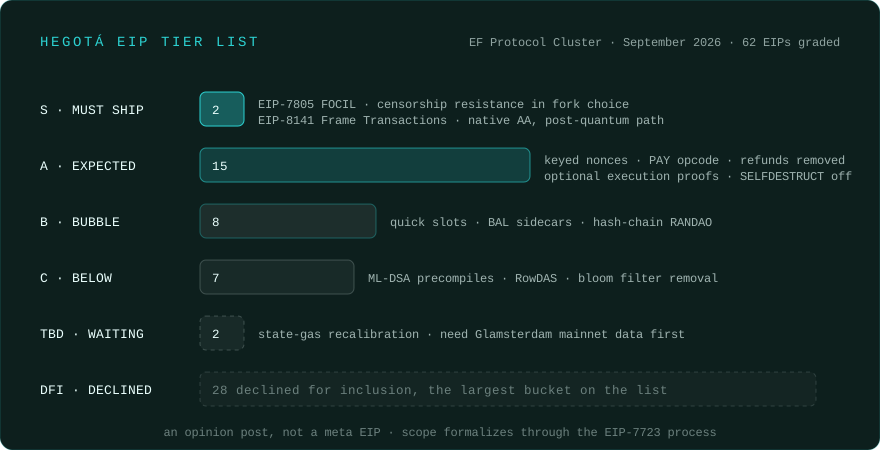
S-tier: the two EIPs that define Hegotá
EIP-7805, FOCIL: censorship resistance gets its seat
FOCIL, fork-choice-enforced inclusion lists, is the design that lost the Glamsterdam consensus headliner seat to ePBS in 2025, when the debate came down to restructuring the block pipeline first versus censorship resistance first. Hegotá reverses that ordering. FOCIL is now the must-ship consensus change.
The mechanism: each slot, a committee of validators publishes inclusion lists, transactions they agree must be included, and fork-choice rules prevent the block from being valid without them. Today a small set of specialized builders constructs nearly all blocks, and nothing in the protocol forces them to include any particular transaction; the pipeline our ePBS deep dive describes makes that concentration explicit. FOCIL gives the validator set a protocol-enforced way to guarantee inclusion even when builders would rather not cooperate, which directly caps how much censorship power the builder market can accumulate. It arrives with a companion, EIP-8369 (VOPS profiles for FOCIL eligibility), graded A, that defines which validators participate.
If you run a searcher or a trading bot, FOCIL is the Hegotá item to track: guaranteed inclusion changes what builders can threaten, what private orderflow is for, and how inclusion guarantees get priced. None of that bites until 2027, but the auction design work starts now.
EIP-8141, Frame Transactions: native account abstraction, quantum-ready
The execution headliner is Frame Transactions, and it is the more radical of the two. A frame transaction is a single transaction composed of frames, ordered steps whose execution and gas payment rules are defined by the account’s own code rather than hardwired into the protocol. That gives Ethereum a native account abstraction path (no ERC-4337 bundler infrastructure, no separate mempool, no paymaster contracts) and, critically, it decouples signature verification from ECDSA. Accounts can verify with post-quantum schemes, rotate or retire keys, and sponsor gas for other accounts, all inside a standard transaction.
This is where the quantum story stops being roadmap prose and becomes an EIP. The EF’s stated long-term objective is a quantum-resistant L1 by the end of 2029, and frame transactions are the migration vehicle: existing ECDSA accounts keep working, while new and upgraded accounts move to quantum-safe signature schemes through the frame mechanism rather than a flag-day rewrite of every wallet.
The A-tier carries the rest of the package: EIP-8250 (keyed nonces) and EIP-8272 (recent roots) are frame transaction plumbing, and the extensions, EIP-7906 (transaction assertions via a state-diff opcode), EIP-8298 (SETCODEFROM code reuse), and EIP-8151 (account-code-restricted ecRecover), round out what account code can safely do.
A-tier: the supporting cast
Beyond the frames package, the fifteen A-tier EIPs are mostly hygiene with consequences:
- EIP-3298 removes gas refunds entirely. Glamsterdam’s EIP-7778 already stopped refunds from counting toward block space; removing the refund mechanism outright is the end of a decade of gas-token-style weirdness.
- EIP-4758 deactivates SELFDESTRUCT. Glamsterdam’s EIP-8246 removes its burn; Hegotá finishes retiring the opcode.
- EIP-5920 adds a PAY opcode, a dedicated way to transfer ETH without calling into the recipient, the safe-send primitive contracts have wanted since the reentrancy era.
- EIP-8015 removes the deposit and eth1data fields from beacon blocks, shedding merge-era machinery.
- EIP-8365 retires BLS withdrawal credentials, part of the post-quantum cleanup: BLS signatures are not quantum-safe either.
- EIP-8383 shortens the CL block retention window and EIP-8334 bundles attestation propagation, both consensus-layer efficiency work.
- EIP-8025, optional execution proofs, lets nodes verify blocks via zero-knowledge proofs instead of re-execution (an early, optional version of the lean roadmap’s zkEVM future).
- EIP-8279 (BAL byte floor) and EIP-8131 (unified transaction content floor) extend Glamsterdam’s block access list and calldata work.
B, C, and the two that wait for Glamsterdam data
The B-tier is where delivery risk lives. The headline name is EIP-8198, Quick Slots (shorter slot times), which carries the heaviest requirements of anything on the list: a full specification, a working prototype, downstream impact analysis, and proof it does not complicate decoupled consensus. Do not plan around it, but if it ever ships it matters enormously to anyone racing the chain. Also on the bubble: EIP-8146 (BAL sidecars), EIP-8237 (independent CL/EL sync), EIP-8321 (hash-chain RANDAO), EIP-7709 (read BLOCKHASH from storage), and three transaction-lifecycle refinements (8253, 8077, 8374).
The C-tier contains one telling entry: EIP-8355, ML-DSA verification precompiles (native verification for the NIST-standard post-quantum signature scheme), graded below the line. The reasoning the tiers imply is consistent: frame transactions are the quantum migration path, so a dedicated PQ precompile is a nice-to-have rather than a load-bearing piece. RowDAS distributed blob reconstruction (8371), bloom filter removal (7668), and the EVMification proposals (8200, 7666) round out C.
The two TBDs, EIP-8368 (CPSB recalibration) and EIP-8372 (normalized state gas limit), are explicitly downstream of Glamsterdam: they recalibrate the state-gas pricing that EIP-8037 introduces, and the EF wants mainnet measurements from the live repricing before grading them. This is the pipeline working as designed: price state on mainnet first, then tune.
What to do with this, by audience
Application developers: nothing breaks and nothing is actionable yet. The durable takeaway is directional: frame transactions are where wallets, gas sponsorship and key management are heading, so new account-system design should assume native account abstraction lands in 2027 rather than betting further on 4337 infrastructure.
Searchers and builders: FOCIL is the one to model. Inclusion-list guarantees change the power balance between builders and the validator set that ePBS just formalized; the combination (ePBS in Glamsterdam, FOCIL in Hegotá) is the protocol absorbing the entire block-building market in two steps. The timing pressure we described for ePBS is unchanged; FOCIL adds a censorship-resistance floor underneath it.
Node operators: watch EIP-8383 (shorter CL retention) and the A-tier networking items when client releases start naming them; both touch what you store and serve. Hegotá testnets are a post-Glamsterdam problem; there is nothing to run yet.
FAQ
When does Hegotá ship?
No date exists. Glamsterdam is targeted for Q4 2026 on mainnet, and Hegotá follows it, with current planning pointing at 2027. The tier list published September 7, 2026 is a pre-formal scoping opinion; the meta EIP and devnet schedule come later.
Is the Hegotá tier list binding?
No. It is the EF Protocol Cluster’s published opinion, built from 397 individual grades across 62 EIPs, ahead of the formal Proposed/Considered/Scheduled process that EIP-7723 defines. Glamsterdam’s own history says the signal is strong but not final: its scope changed meaningfully between devnet start and testnet season.
Does Hegotá make Ethereum quantum-resistant?
Not by itself. The EF’s stated objective is a quantum-resistant L1 by December 2029, and Hegotá ships the migration vehicle: frame transactions decouple accounts from ECDSA, and BLS withdrawal credential retirement removes another quantum-vulnerable primitive. The full transition spans multiple forks, covered in our lean roadmap explainer.
What happened to FOCIL in Glamsterdam?
It was the other finalist for the consensus headliner seat and lost to ePBS in 2025: declined for Glamsterdam, not abandoned. Hegotá’s tier list makes it the must-ship consensus headliner, so the censorship-resistance half of that debate arrives one fork later.
Conclusion
Hegotá’s shape, as of September 2026, is two big ideas and a long cleanup tail: FOCIL puts inclusion guarantees into fork choice, frame transactions give Ethereum native account abstraction and its post-quantum on-ramp, and fifteen A-tier EIPs retire the machinery those two make obsolete: refunds, SELFDESTRUCT, BLS credentials, merge-era deposit fields. The list is an opinion, not a schedule, and the fork has no date beyond “after Glamsterdam.” We will keep this page current as the meta EIP appears; for the fork that ships first, start with our Glamsterdam hub, and watch the remaining testnet dates on the Glamsterdam countdown.