Ethereum runs on a network of thousands of computers called nodes. These nodes store blockchain data, validate transactions, and let external software (wallets, dApps, bots) talk to the network. If you’ve ever wondered what’s actually running behind MetaMask or your favorite DeFi app, it’s nodes, and this post explains how they work.
What Is Ethereum and Why Does It Matter?
Ethereum is a decentralized platform for running smart contracts, programs that execute automatically based on coded rules, and decentralized applications (dApps) built on top of them. DeFi, NFTs, and most of the interesting stuff in crypto runs on Ethereum.
The network is maintained by a global set of nodes that store transaction data, validate operations, and agree on the current state of the blockchain. No single entity controls it.
Ethereum Nodes: The Network’s Backbone
An Ethereum node is a computer running client software that connects to other nodes, enforces protocol rules, and shares data. Specifically, nodes handle three things:
- Storing the blockchain: Each node keeps a copy of the ledger, so the data is replicated across the network.
- Validating transactions: Nodes check that transactions and smart contract calls follow the rules before accepting them.
- Reaching consensus: Nodes agree on which blocks are valid, keeping the network consistent without a central authority.
This peer-to-peer design makes Ethereum resistant to censorship and single points of failure. Nodes also serve as the interface between the blockchain and external software, which we’ll get to in the RPC section.
Types of Ethereum Nodes
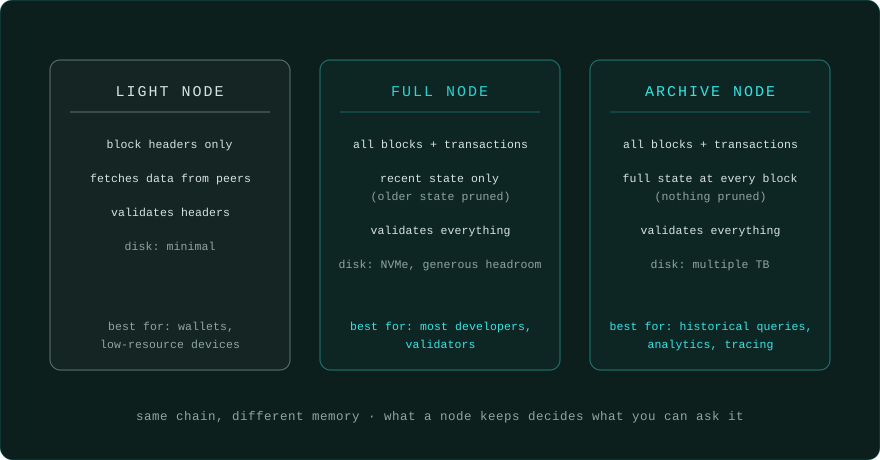
There are three main types, each with different tradeoffs:
-
Full Nodes Store the current blockchain state and validate all transactions. This is what most developers and validators run. Disk requirements depend on client, pruning mode, and date; as of June 2026, plan for NVMe storage with generous headroom rather than sizing to a single old number.
-
Light Nodes Download only block headers and request specific data from full nodes as needed. Good for low-resource environments (mobile, cheap VPS), but limited in what they can do independently.
-
Archive Nodes Store the full blockchain state at every block height, not just the current one. Needed for historical queries (e.g., “what was this account’s balance at block 15,000,000?”). Storage is measured in multiple terabytes and varies dramatically by client, configuration, pruning flags, and chain growth, so check current client docs before buying disks.
Which one you need depends on your use case. Most developers are fine with a full node.
The Role of Nodes in the Ethereum Network
Nodes handle the core functions that keep Ethereum running:
- Transaction validation: Checking signatures, confirming balances, and enforcing protocol rules before a transaction is accepted.
- Consensus: Under Proof of Stake (PoS), validator nodes stake ETH to propose and attest to blocks. This is how the network agrees on what’s canonical.
- Data propagation: Nodes gossip transactions and blocks to each other, keeping the entire network in sync.
Nodes and Off-Chain Software: The Power of RPC
Most Ethereum applications don’t run on-chain; they’re normal programs (wallets, trading bots, analytics dashboards) that need to read from and write to the blockchain. They do this through RPC (Remote Procedure Call), a standard interface that nodes expose.
How RPC Works
A node’s RPC interface accepts JSON-RPC requests over HTTP or WebSocket. Some common examples:
- MetaMask calls
eth_getBalanceto show your ETH balance. - A DeFi frontend calls
eth_callto read smart contract state. - A bot calls
eth_sendRawTransactionto submit a signed transaction.
You can use a third-party RPC provider like Infura or Alchemy, or run your own node. Running your own gives you:
- Privacy: Your queries don’t go through a third party.
- Reliability: No dependency on someone else’s uptime.
- Customization: Configure caching, rate limits, and access controls however you want.
How to Set Up Your Own Ethereum Node
Here’s the short version:
-
Pick a node type Full node for most use cases, archive node if you need historical state queries.
-
Pick your clients Since the Merge, a working Ethereum node is actually two programs running side by side: an execution client and a consensus (beacon) client. You need both; the execution client handles transactions and state, while the consensus client follows Proof of Stake and tells the execution client which blocks are canonical.
Execution clients:
- Geth: The most widely used, written in Go.
- Nethermind: Fast, written in C#.
- Besu: Enterprise-oriented, written in Java.
Consensus clients:
- Lighthouse (Rust), Prysm (Go), Teku (Java), Lodestar (TypeScript), or Nimbus (Nim).
Pick one of each and run them together; they communicate over a local authenticated endpoint (the Engine API).
-
Hardware requirements (full node)
- 8GB RAM minimum, 16GB recommended
- NVMe SSD with enough headroom for both clients. Exact requirements move quickly with chain growth and client defaults; check current execution-client and consensus-client docs before sizing production hardware.
- Stable internet connection
-
Install and configure
- Choose a network: mainnet, or a testnet like Sepolia for development.
- Set a data directory.
- Enable RPC if needed (
--httpflag in Geth).
-
Sync Start the client and wait for it to sync. Full sync can take a day or more depending on your hardware and internet speed.
-
Enable RPC Expose an endpoint at
http://localhost:8545. Make sure to secure it; don’t expose your RPC port to the public internet without authentication. -
Maintain Keep the client updated. Monitor disk usage. Ethereum upgrades happen regularly.
Benefits of Running an Ethereum Node
- Privacy: Verify data yourself instead of trusting a provider.
- Decentralization: More nodes make the network harder to attack or censor.
- Control: Full autonomy over your RPC endpoint and configuration.
- Learning: There’s no better way to understand Ethereum than running a node.
Common Challenges
- Disk space: The chain is large and growing. Budget with headroom and current client documentation, not stale blog numbers. NVMe SSDs help with sync speed.
- Security: An exposed RPC endpoint is an attack surface. Use firewalls, authentication, and keep your client patched.
- Keeping up with upgrades: Ethereum evolves quickly. Follow client release channels and upgrade promptly for hard forks.
What’s Changing for Nodes
Ethereum’s roadmap continues to evolve:
- Proof of Stake shipped with the Merge in September 2022, replacing energy-intensive mining with validator staking. Running a validator now requires 32 ETH and a full node (both execution and consensus clients).
- EIP-4844 (Proto-Danksharding) went live in 2024, introducing blob transactions that reduce Layer 2 data costs. Full danksharding is still in development.
- Layer 2 rollups (Optimism, Arbitrum, Base, etc.) handle most user-facing transactions off the main chain, reducing the load on L1 nodes while inheriting Ethereum’s security.
These changes are making it cheaper to use Ethereum and more efficient to run nodes.
Conclusion
Nodes are the infrastructure that makes Ethereum work. They validate transactions, store the blockchain, and provide the RPC interface that every wallet, dApp, and bot depends on. Running your own gives you privacy, reliability, and a much deeper understanding of how the network actually operates.